
I have been thinking about this new show curated by Didi Menendez and David Hummer, Iconic, on view at the Wausau Museum of Contemporary Art in Wausau, Wisconsin.
I wondered: what is iconic about Wausau, or about the WMOCA?
I have been in Wisconsin a couple of times. I’ve done road trips from Minneapolis to Milwaukee, with a stop in Chippewa Falls. I’ve driven from Chicago to Milwaukee, passing through Madison. But I have never been to Wausau, and my experience of Wisconsin is far from iconic.
So why organize a show around the theme Iconic in the least iconic place I can think of?
I’ve known Menendez for several years. I’ve shown my work in exhibitions curated by her, and my intuition is that she is thinking about a different kind of iconicness. She often draws from poetry and songs—there is a strong connection to music and literature. Previous shows like Horse (With No Name) and Desperately Seeking Madonna reflect that influence.
So the first thing that came to mind when she organized a show around Iconic was music, artists, people, poets.
From that, I expected nostalgia—icons from music and culture, maybe from the seventies and eighties, perhaps Charles Bukowski or Joseph Beuys. And since Menendez is a strong advocate of figurative art, I assumed figurative work would be the core of the show.
I browsed the works with that expectation, and I wasn’t far off.
Across twenty-two works, Iconic presents a range of positions.
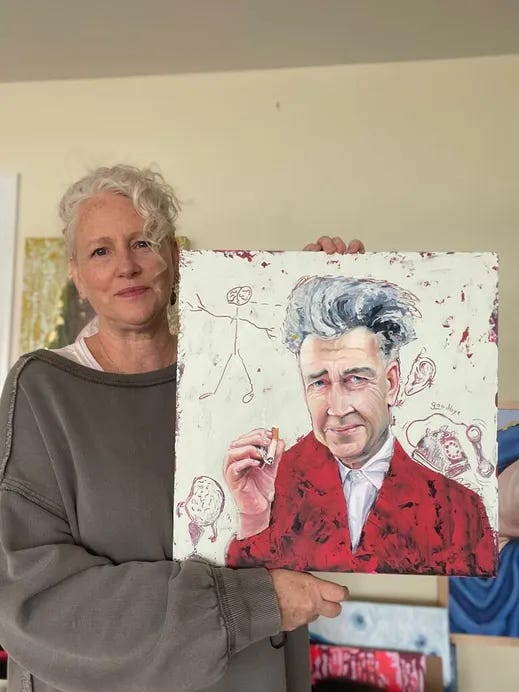
As expected, some are direct: portraits of figures already fixed in cultural memory—David Lynch by Jeanne May, or Natalie Wood and Henry Cavill by John Hyland. These works follow a clear logic: they depict what is already known to be iconic. Maybe too iconic, in the manner of Andy Warhol’s portraits—but with one important difference. Warhol identified a candidate and elevated it into an icon. Here, the artists begin with figures that are already icons and reaffirm that status.
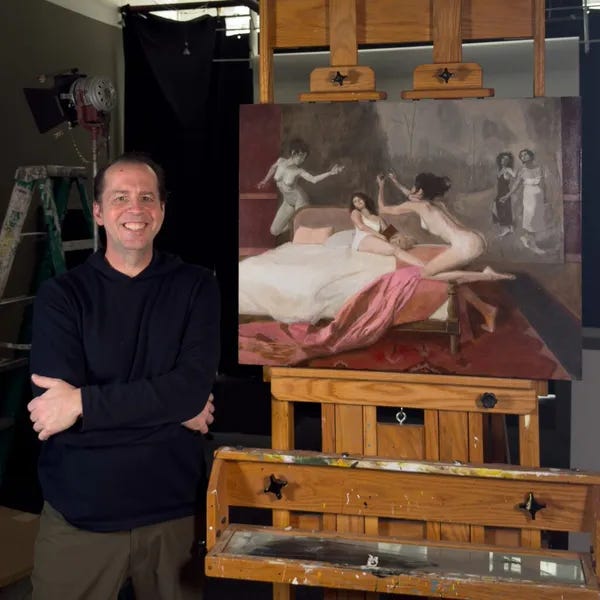
A second group moves toward literature and myth: Ophelia by Alexandra Telgmann, Sappho by David E. Morris, Europa by Ivan Pazlamatchev. These figures persist through narrative rather than visibility. Their iconic status comes from repetition across time.
This position is particularly interesting because we don’t have a fixed image of these subjects. Instead, we rely on symbols to recognize them—much like in paintings of saints, where attributes define identity: Saint Peter with keys, Saint Sebastian with arrows. Here, the same mechanism applies—the bull with Europa, the floating body of Ophelia. The symbol becomes the anchor
.
Another group turns to engineered forms—cars and planes—in works by Shannon Fannin. Again, symbols of the technological era, icons of progress.
But the exhibition becomes more convincing when it drops recognition altogether.
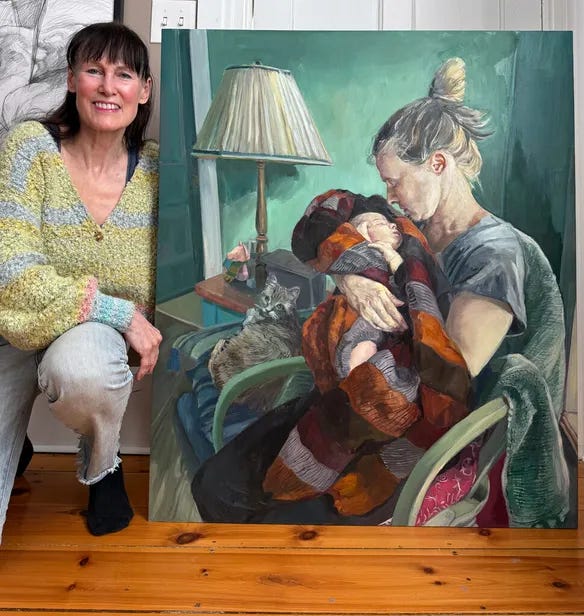
A quieter set of works turns inward. These are not portraits of who we all know, but of what the artist knows. Among them, Aki Kano’s Portrait of the Artist Shopping stands out: a large watercolor of the artist inside a fitting room, surrounded by clothes, suspended in a banal but exact moment. It is not recognizable in any conventional sense, yet it holds

.
This last group is contradictory. It proposes a subtle variation of what “iconic” can be, but it also feels like the kind of work that could fit into almost any figurative show. Are they included because the theme needs to expand, or because this interior gaze can also be considered iconic?
I have barely encountered figures like Henry Cavill or David Lynch in real life. For me, they exist through mediated images—cinema, magazines, popular culture—without direct experience. The literary approach, on the other hand, allows more freedom; we construct these figures ourselves through imagination.
Maybe that’s why I keep returning to this last group—ordinary people, engaged in ordinary acts—as the most convincing form of the iconic in this exhibition
.
The only way to answer that is to take a closer look. It’s not necessary to travel to Wausau—you can browse the works online through 33 Contemporary on Artsy. But seeing them in person at the Wausau Museum of Contemporary Art might justify the road trip.
In the end, that’s how art works—not something to see once and discard, but something to return to, allowing it to open new ways of thinking.
Beautifully written. So glad you liked the exhibition :)